Sts Constantine and
Helene
Adapted from the Late Very Rev Nicon D Patrinacos
 Flavius
Valerius Constantinus, the son of the emperor Constantius
Chlorus and Helena, was probably born in Naissus, Serbia, on
27 February in 272 or 273 AD. Soon after his father's death
in Britain on 25 June 306, Constantine was raised to the
purple by the army and the Praetorian Guard.
Flavius
Valerius Constantinus, the son of the emperor Constantius
Chlorus and Helena, was probably born in Naissus, Serbia, on
27 February in 272 or 273 AD. Soon after his father's death
in Britain on 25 June 306, Constantine was raised to the
purple by the army and the Praetorian Guard.
It was not until 312, after defeating his brother-in-law and rival Maxentius at the Milvinian Bridge, that Constantine became the senior ruler of the Roman Empire. It was at this battle that Constantine adopted his famous battle banner (Labarum) as the champion and sign of Christianity. As it is related, Constantine found himself at a decisive crossroads, not only of his own career but also of the future of the Roman Empire. He had defeated Maxentius, but the outcome of the impeding confrontation was very much in doubt. While deeply concerned about his ability to defeat Maxentius, Constantine, on the evening of 27 October 312, had a vision of a cross in the sky outside of the city of Rome. On the four sides of the cross he saw written the Greek words "EN-TOU-TW-NI-KA" (BY THIS YOU SHALL WIN). Constantine immediately ordered a battle standard of the design and words he had seen in the sky and placed it as the head of his army as he began to march against Maxentius. Maxentius' army was annihilated and he himself was drowned in the Tiber river. Shortly afterwards, the Christian faith not only was tolerated in the Empire but accorded imperial favour. In 313, Constantine and his other brother-in-law and rival Licinius met at Milan and agreed to legally recognise the Christian Church and to tolerate all religions equally without any interference from the state. This decision has come to be known as the Edict of Milan. In 314, 316, and 324, he repeatedly defeated his last remaining rival Licinius. Once he had overcome him, he was the undisputed ruler of the Roman Empire.
Constantine's policy from the beginning was to bring the Christian Church into close relationship to the point of identification between Church and State. This resulted in his being concerned with the internal affairs of the Church even though he was not a baptised Christian himself and never became such until shortly before his death. Divergent teachings within the Church had appeared very early. Some of them became heresies and began to seriously disturb the Church. In 313, the Donatist schismatics in Africa appealed to Constantine to adjudicate their controversy with the Church of that province. At their request, Constantine referred the case first to a commission of bishops and then to a Synod (Arles 314). When the controversy continued, Constantine decided to hear the case himself in 316. In all trials the verdict was against the Donatists. In answer, they attacked not only their ecclesiastical authorities but also the imperial government encouraged riots and raids. Constantine found himself obliged to apply his verdict with repressive measures. This Donatist controversy is the first instance in which the internal affairs of the Christian Church were brought before an Emperor to be adjudicated. This opened the way for a de facto identification between Church and State and granted the head of the state the right not only to intervene in the internal affairs of the Church, but to issue as well binding decisions. It is from this point on that in terms of reality the Orthodox Church became a state religion with all advantages and disadvantages that a marriage of this kind has yielded to her through the ages.
A few years later and in answer to another and more serious controversy within the Church, the Arian dispute about the Person of Christ, Constantine convened the 1st Ecumenical Council of Nicaea in Bithynia during June, 325. The emperor himself presided over this very important Universal Council of the Christian Church although he himself was still not baptised Christian. As it is known, this Council resulted in the complete victory for Orthodoxy and in the statement of most of the articles of the Creed which we today and is known as the Nicene-Constantinopolitan Creed. The Nicaean Council also established a special, privileged, status for the Bishop of Jerusalem. At the same time, Constantine uncovered the site of the crucifixion, burial, and resurrection of Jesus in Jerusalem, and built on it the Church of the Holy Sepulcher.
The Nicene Council was the most profound event of Constantine's reign because it set a precedent for future Councils. When either the Roman Catholic or Eastern Orthodox Churches have major dogmatic or disciplinary problems to resolve, they would convene an Ecumenical Council to settle them.
Constantine gradually broke away from the old traditions of Rome and after his victory at Chrysopolis in Asia Minor against Licinius (324), he became sole Emperor and immediately moved his capital from Rome to Byzantium which he rebuilt, gave it his name. Constantine had the city officially dedicated on 11 May. The city was only an imperial residence until 359 when it became the official capital of the empire.
All through his reign he went to great pains to bring peace within the Church and between pagans and Christians. It is difficult to state at which time he decided to embrace Christianity, but his attitude towards the Christian religion was consistently one, not only of believing but of rearing a deep and lasting respect for it. The fact that he was baptised just before his death does not prove that he was not a practicing Christian before that, but rather points to the practice at the time of deferring baptism because of fear of sinning after it and thus proving unable to be saved - as a current teaching was wrongly advocated. In 321, he decreed that Sunday be observed as a public holiday. He liberally endowed church buildings, especially at Holy Places in Palestine, such as the Church of Resurrection which his mother Helena had erected.
The centralisation of the Empire at Constantinople as the locus of power, and Constantine's preference for Christianity opened the way for an increasing control of the Eastern Church by the Emperor of Byzantium. In contrast, the Church in the West and its heading bishop, the Bishop of Rome, was allowed by circumstance to carry on his ecclesiastical leadership unhindered by State influence and intervention. Thus, the Bishop of Rome became the more prominent figure, lay or ecclesiastical, in the west. It is from the 4th century that the Papacy began to assume its ever increasing secular importance and the monocratic position it reached in the Middle Ages.
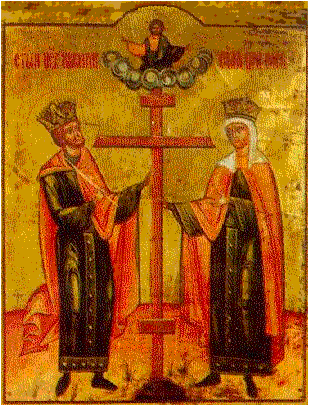
Constantine tempered the criminal law and the laws on debts, improved the conditions of slavery, and provided for poor children; as a result exposing unwanted babies was lessened. He freed celibates and unmarried persons from special taxation, introduced laws against sexual licentiousness, and exempted Christian clergy from military service. Constantine died on 22 May 337 near Nicomedia on his way east to fight the Persians. For his services to the Christian Church, Constantine has been named the 13th Apostle by the Orthodox Church and is venerated as a saint together with his mother Helena. The feast day of Sts. Constantine and Helena is celebrated on May 21st.